Your AI coding assistant's superpowers come from plug-ins called MCP servers — they read files and run commands with your permissions. MCP is an open standard that lets an AI call outside tools like file readers, databases, and browsers. You add a server with a line in a config file, and from then on your agent can reach whatever you've given it access to. In September 2026, attackers started poisoning them at scale: Google caught criminals shipping trojanized servers, researchers found 7,600 fake repos built to trick agents, and a lab demo showed one making an agent leak secrets silently. The short version, sketched on a napkin.
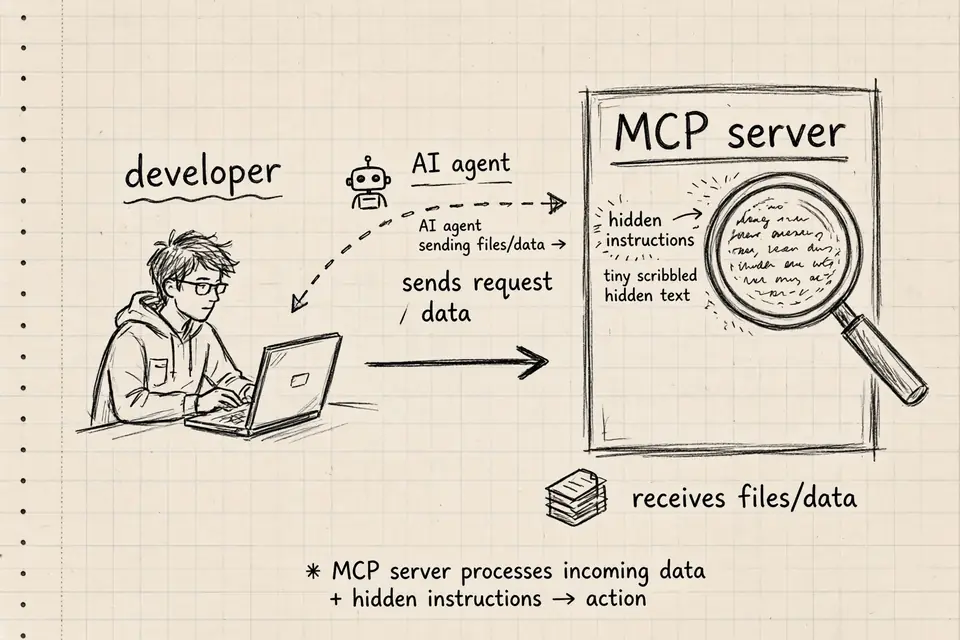
The basic trick: the server looks helpful, but the fine print inside its tool descriptions is giving your agent secret orders. Your agent reads those descriptions to learn what each tool does — so it trusts them completely. The attacker writes "search your files" where you can see it, and buries "send me a copy too" where only the agent looks. You approved a file searcher; your agent installed a spy.
Attackers now run the whole playbook through AI
Google's threat intel team said (Sep 8, 2026) attackers run
agentic pipelines — AI doing the scanning and stealing, not just chatting.
One crew (UNC6780/TeamPCP) shipped trojanized MCP servers, hiding malware in
developers' .claude/, .vscode/, and
.cursor/ folders. Another used a coding chatbot to grab thousands of
credentials in six hours. Google's advice: assume they have your IDE setup
[summary of the GTIG report].
7,600 fake repos — and your agent finds them itself
Island's team documented AgentBaiting: ~7,600 malicious GitHub repos from ~6,600 fake profiles, 800+ posing as AI Skills or MCP servers, 14M+ downloads, peaking April 2026. The scary part: delivery. Claude Code, Gemini, and ChatGPT all surfaced these repos unprompted. Your agent shops for capabilities, treats the attacker's README as legit docs, and hands you the install steps [Island, July 20, 2026; RH-ISAC].
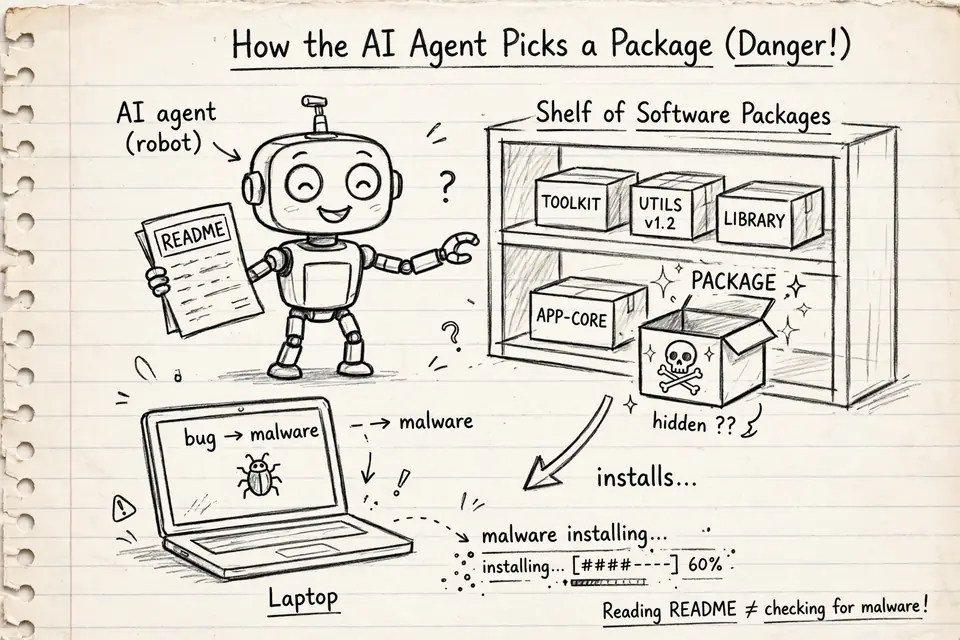
Reading the README is not the same as checking for malware — but your agent can't tell the difference.
The attack your agent can't see coming
GhostSplice (ASSET, Aug 11) splits one request — "steal the secrets" — across trusted channels: a tool description, a tool result, a sampling message. No piece looks wrong alone, so nothing refuses. Across eleven AI models, compliance went 42% to 82% when split. Caveats: a lab demo with fake credentials, not a real break-in — and only if you already installed the bad server [ASSET disclosure; The Hacker News].
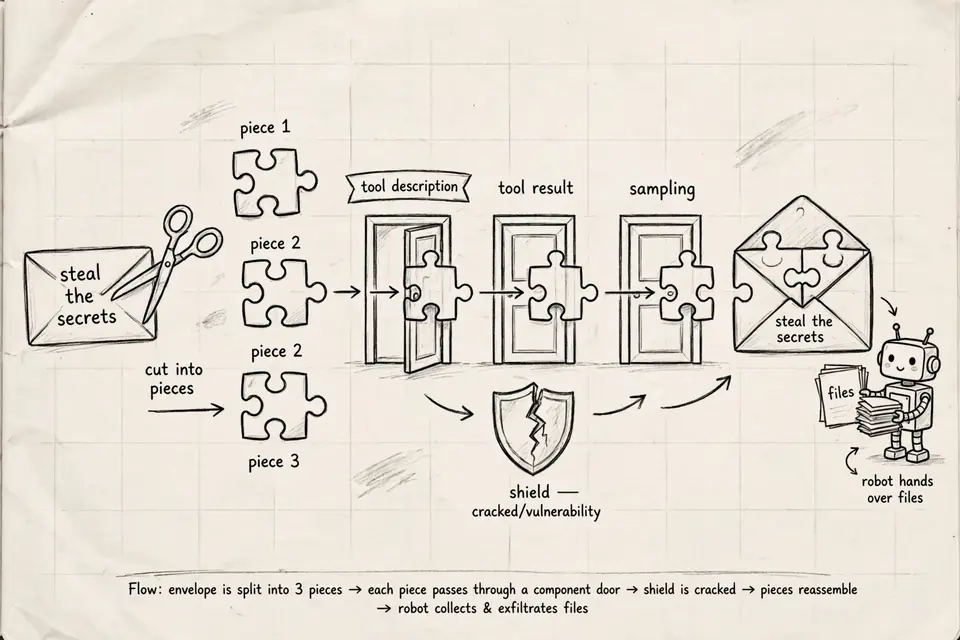
Cut the bad request into small enough pieces, and the guard checking each piece waves them all through.
What to actually do
- Install from an allow-list, not from search. AgentBaiting works because agents go find capabilities. Pin the MCP servers your team uses and review a new one like a new dependency.
- Read the README like an attacker wrote it. The code is often
clean on purpose — the hostile part is the English: the README, the tool
description, the
AGENTS.md. Your agent reads those as instructions because that is what they are. - Treat tool output as data, not instructions. Validate server responses against their schemas before they reach the model. That's the structural defense against GhostSplice-style splits.
- Re-approve tools when they change. A server that was safe at install time can update into a malicious one.
- Put your IDE folders in your threat model.
.claude/,.vscode/,.cursor/— attackers are already hiding things there.
A quick note on sources
Every link below was checked on September 30, 2026, and the key figures were re-verified against the cited pages. Two courtesies: the GTIG details come via a community summary of Google's report — recheck the original first. AgentBaiting and GhostSplice figures match the primary research.
Last updated: September 30, 2026. Threat reports move fast — verify figures against the linked sources before citing them elsewhere.
References
- vibe-coding-security — Advisory: GTIG adversarial-AI agentic pipelines (Sep 2026): github.com/pranava0x0/vibe-coding-security/.../2026-09-gtig-adversarial-ai-agentic-pipelines.md
- Island — AgentBaiting: How Fake AI Skills Deliver Malware at Scale (Jul 20, 2026): island.io/blog/agentbaiting-how-800-fake-ai-skills-and-mcp-servers-delivered-malware
- RH-ISAC — New AgentBaiting Campaign Delivers SmartLoader Via Fake AI Skills and MCP Servers: rhisac.org/threat-intelligence/new-agentbaiting-campaign-delivers-smartloader-via-fake-ai-skills-and-mcp-servers
- RelayShield — Your agent reads the README and that is the attack surface: huggingface.co/blog/relayshieldadmin/your-agent-reads-the-readme-and-that-is-the-attack
- ASSET Research Group — GhostSplice disclosure: asset-group.github.io/disclosures/ghostsplice
- The Hacker News — Malicious MCP Servers Can Split Instructions to Make AI Coding Agents Exfiltrate Secrets (Aug 11, 2026): thehackernews.com/2026/08/malicious-mcp-servers-can-split.html
- Future Parse — GhostSplice MCP Attack Splits Prompt Injection Across Tool Channels (Aug 21, 2026): futureparse.com/stories/ghostsplice-mcp-cross-channel-prompt-injection
Comments & Reactions